Ethereum Moves Toward a More Unified L2 Economy — Why It Matters for CT3

Rodrigo Pereira
Chief Marketing Officer
From Scaling to Fragmentation
Ethereum’s rollup-based scaling strategy has solved one of the ecosystem’s core technical challenges. Transactions have become cheaper, throughput has increased, and Layer 2 networks have evolved into a critical part of Ethereum’s scaling architecture.
At the same time, a new issue has emerged — fragmentation. Liquidity is spread across multiple L2s, bridges remain a constant source of friction, and both users and developers operate not within a unified system, but across a set of disconnected environments.
What the Ethereum Economic Zone Proposes
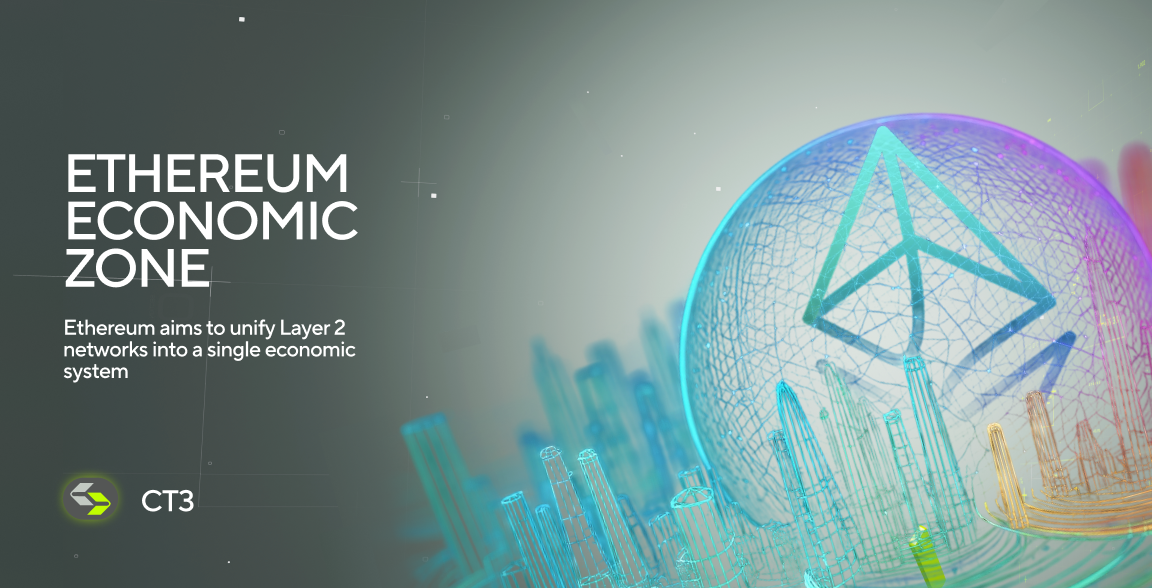
The Ethereum Economic Zone (EEZ) is introduced as an L1↔L2 framework designed to turn rollups into extensions of Ethereum rather than isolated execution domains.
At the core of this concept is synchronous composability. Smart contracts on connected rollups would be able to interact with Ethereum mainnet and other EEZ-compatible rollups within a single transaction.
The model is positioned as a shared environment with unified liquidity, Ethereum-anchored security, and ETH as the base gas asset.
Why This Matters for Web3 Infrastructure
If this architecture gains real adoption, projects will no longer need to constantly choose a single L2 network or duplicate the same infrastructure stack across multiple ecosystems.
Instead, development can increasingly take place within a broader Ethereum economy, where applications, liquidity, and user access are less dependent on fragmented environments.
For infrastructure-level Web3 products, this shift is especially important. It reduces redundancy, simplifies integrations, and creates a more stable foundation for scaling.
What This Could Mean for CT3
For CT3, this development represents a positive signal. CT3 Secure Storage is positioned as a decentralized storage product with NFT-based access keys and Polygon-linked payment logic, while its broader roadmap includes token and on-chain preparation and movement toward a larger ecosystem.
In a more unified Ethereum environment, CT3 gains additional strategic flexibility. The project becomes less dependent on the long-term dominance of any single network, while its future infrastructure and token logic can be positioned within a wider Ethereum landscape.
More Flexibility, Less Dependence on a Single Network
This does not imply a shift away from Polygon or a change in CT3’s current blockchain alignment.
Rather, it reflects a broader market evolution, where infrastructure projects may become less tied to strict ecosystem boundaries. If Ethereum moves toward a coordinated model where multiple rollups function as a single economic zone, projects like CT3 will have more room for scalability, interoperability, and balanced growth without overreliance on a single network narrative.
A Positive Direction for Web3 Infrastructure
EEZ is still at the framework stage, with further specifications, benchmarks, and developer tooling yet to be released.
However, the direction itself is already meaningful. The conversation around Ethereum scaling is shifting from a pure focus on throughput toward the economic cohesion of the ecosystem.
For CT3 and other infrastructure-level Web3 projects, this is a strong signal. A more unified Ethereum environment could enable better composability, broader reach, and more sustainable long-term growth.