CT3 and Viantis IT Solutions Sign 12-Year Data Storage Agreement

Rodrigo Pereira
Chief Marketing Officer
We at CT3 are pleased to announce a 12-year data storage agreement with Viantis IT Solutions Ltd. The cooperation covers backup and disaster recovery for the infrastructure the company maintains for its clients, long-term archiving of completed projects, and storage of working materials from ongoing projects.
This segment differs from a typical corporate archive on two counts. An IT consulting company stores copies of its clients' systems alongside its own documents. Losing such a copy means losing the ability to restore someone else's business after a failure. These materials also outlive the projects that produced them. The configuration or handover package from a completed implementation is requested years later, when the system needs to be extended, migrated or rebuilt. The 12-year term of the agreement matches this horizon and is the longest among CT3's publicly announced corporate contracts.
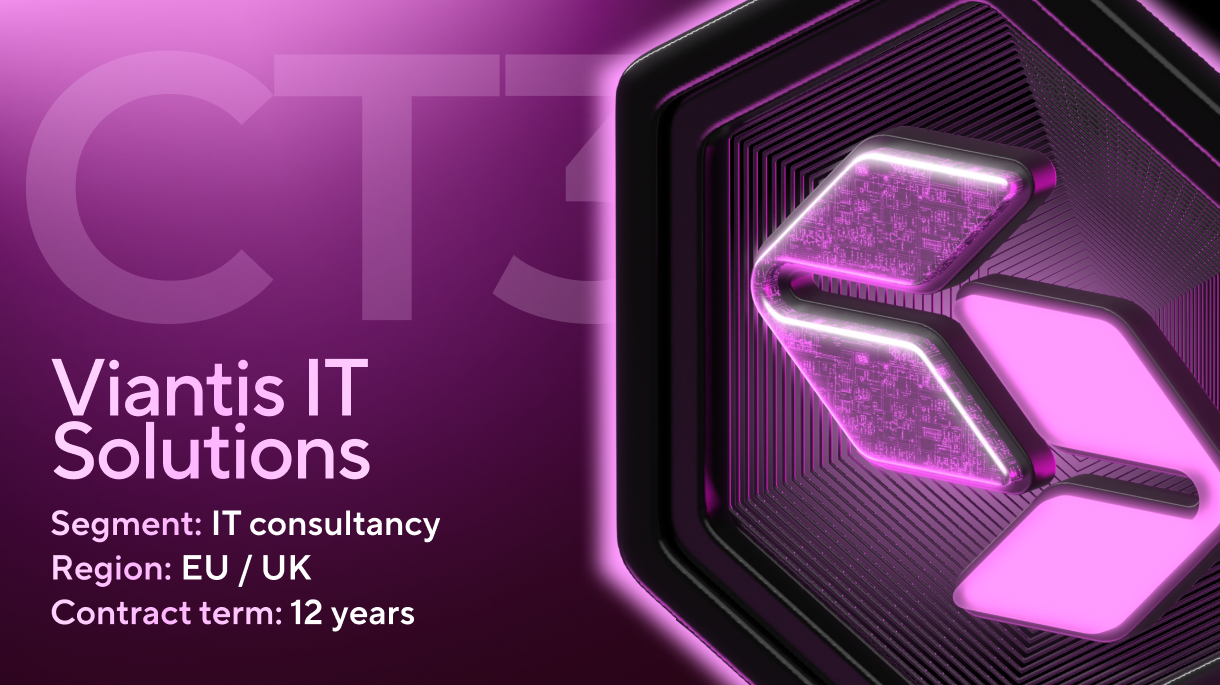
Partnership details
The agreement covers structured and unstructured data that accompanies the company's consulting work: backups of client systems, project documentation, configurations and handover packages.
Integration proceeds in stages. In the first stage, the accumulated archive of closed projects and historical documentation is migrated to CT3 Secure Storage. Automated backups from clients' network storage devices are connected next. After that, hot storage for materials on active client projects goes live.
Access to the corporate storage segment is managed through a corporate NFT key on Polygon. Its metadata lists the company name and the contract term, and anyone can verify the key on OpenSea.
Business continuity: backups directly from client NAS devices
Many Viantis clients keep their working data on QNAP and Synology network storage. For small and medium-sized businesses, a NAS often serves as the primary store of working data. It is also the single point where that data can be lost: through hardware failure, ransomware that hits shared folders, or an office fire or flood.
Under the agreement, backups from these devices are sent directly to CT3 through tools already built into the NAS:
- QNAP: Hybrid Backup Sync, where CT3 is added as a backup destination.
- Synology: Hyper Backup, which sends versioned copies to CT3 on a set schedule.
The connection runs through an S3-compatible interface that both systems already support, so no additional server or agent is required. Schedules, retention periods and versioning stay in the NAS console the administrator already uses.
Before transfer, every backup is encrypted on the client side, then fragmented and distributed across independent nodes. Each backup receives its own NFT key in a collection that supports updatable metadata, since the archive size changes with every new version. The right to restore data exists as a verifiable on-chain asset rather than as a permission in a provider account. For disaster recovery planning, this means the off-site copy shares no point of failure with the client's office or with any single provider.
Storage model and data architecture
The bulk of the data is placed in cold storage. These are archives of closed projects, historical configurations, handover packages and older backup versions. They do not require regular access but must be preserved unchanged for years. This model provides long-term storage at a predictable cost while keeping the data available at the moment of request.
Part of the data is placed in hot storage. This covers materials on active clients: current project documentation, recent backups and files engineers work with daily. These files must be available immediately, including when a client needs a fast recovery.
The agreement also defines requirements for the geographic placement of nodes. Data and metadata remain within the agreed jurisdiction, the United Kingdom and the EU. Each file is stored in three replicas on verified nodes in the region, compared with two in the standard configuration. This adds a fault-tolerance margin on top of erasure coding, including in the event of a failure on the node operator's side.
Beyond the Contract
The agreement with Viantis IT Solutions opens a new role for CT3: storage that an IT consulting company uses as part of the service it delivers to its own clients. Here continuity is the consultant's obligation to every business it serves, not only a question of protecting its own data.
The case also shows how decentralized storage enters day-to-day IT work without replacing familiar tools. The administrator keeps the same NAS, the same backup schedule and the same console. What changes is the answer to the question a traditional off-site backup leaves open: who controls access to the copy.
In the CT3 architecture, that question is settled before the first backup is sent. Encryption is performed on the client device, a hash on the blockchain confirms integrity, and the right to restore exists as a transferable asset verified on-chain. Continuity no longer depends on an account with a provider, because the architecture enforces it.