CT3 — the Only Storage Platform Where a Payment Transaction Does Not Reveal the Data Owner

Rodrigo Pereira
Chief Marketing Officer
We separated the payment address from the minting address of the NFT access key. The transactional trail no longer leads back to you.
The volume of data humanity creates each year doubles roughly every two to three years. In 2025, that figure exceeded 173 zettabytes; by the end of 2026, analysts expect it to reach 230 zettabytes. Behind these numbers lies an obvious conclusion: data storage has long since become one of the core infrastructure challenges for corporations, developers, and private users alike. But as that problem was being solved technically, another one was growing in its place — less obvious, and far more uncomfortable.
Companies working with confidential data came to a simple realization: entrusting information to AWS or Google Cloud means accepting the operator’s rules of the game — with jurisdictional risks, compliance requests, and an embedded logic in which the provider always knows more about your data than you would like. Decentralized solutions promised an alternative. In many ways, they delivered it. But one question remained unanswered for longer than it should have.
The Problem We Solved
Before this update, the workflow was linear: you paid for access from address A, and the NFT key was minted to that same address A. Logical — but from a privacy standpoint, it was a serious vulnerability.
A blockchain is public by nature. Any observer armed with a standard explorer could see that address A made a payment to the CT3 protocol, and seconds later an NFT landed on that same address A. The conclusion was obvious: the owner of address A uses decentralized storage and holds an access key to a specific body of data. From there, standard on-chain analysis begins: wallet clustering, matching against withdrawals to CEXs, and identity reconstruction through linked transactions. This is exactly how Chainalysis, Arkham, and dozens of lesser-known surveillance tools operate.
The payment transaction itself was legitimate. The problem was that it became an entry point for surveillance — not because someone hacked the protocol, but simply because they looked at a public explorer. For a private user, that is unpleasant. For a business storing sensitive data, it is unacceptable. We understood that and worked on a solution.
How It Works Now
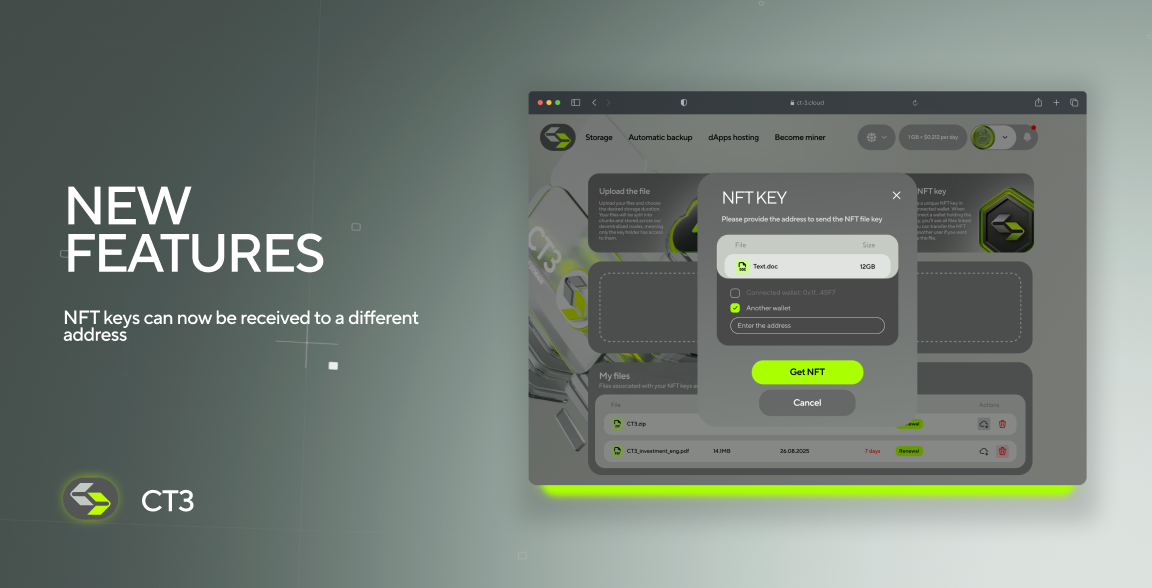
We separated the payment address and the NFT key recipient address at the protocol level — which means you can now make a payment from one Polygon address and mint the NFT access key to any other.
The mechanics are straightforward: you specify address A for payment and address B for minting the access key. Both operations are recorded on-chain — but there is no publicly verifiable link between them, provided the addresses are not connected in some other way. An observer sees a payment from A into the protocol, and that is where the trail ends. Where the access key was sent, who owns it, and whether any link exists at all between the payer and the storage account — the transaction history provides no answer.
It is important to understand what this solution is not. We do not hide the movement of funds, we do not mix transactions, and we do not use anonymizer mechanics. What we do is remove the informational linkage between a financial action and the fact of using storage. That is not the same thing — and the distinction is fundamental, both technically and from a regulatory standpoint. In effect, the solution is comparable to stealth-address mechanics implemented at the user-flow level: no extra technical complexity, no new tools — just two fields instead of one when obtaining access.
The Context in Which This Solution Appeared
We are releasing this update at a moment when pressure on privacy tools in Web3 has reached a historic high and taken on a systemic character. The Tornado Cash and Samourai Wallet cases set precedents that the industry will be processing for a long time: both projects faced criminal prosecution, and the Samourai developers ultimately pleaded guilty and received real prison sentences. OFAC sanctions against Tornado Cash were lifted after a court ruling, yet the criminal case against the project’s co-founder is still ongoing. The regulatory signal is unambiguous: tools built around transaction obfuscation are under scrutiny regardless of their creators’ stated intentions.
In Europe, the same logic is being implemented through legislation. Regulation (EU) 2024/1624 enters into force on 1 July 2027 and requires crypto exchanges and custodial services to conduct enhanced verification for operations involving wallets above €1,000. Anonymous crypto accounts on regulated platforms will effectively be prohibited.
We designed this new function precisely with that landscape in mind. Address separation does not create regulatory risk for the user — it removes an informational trail without violating any transparency requirements.
The user pays publicly. Where the access key arrives is their own business.
Who This Changes the Real Use Case For
The first category of users is obvious: people for whom privacy is a working tool, not an abstract value. Journalists with sensitive sources, lawyers handling confidential client materials, activists operating in jurisdictions with high levels of digital surveillance — for each of them, the separation between the payment address and the storage address is the difference between a protected tool and a potential point of compromise.
The second category is less obvious, but significantly more important in market terms. Any company dealing with medical records, legal archives, or financial reporting has long since solved the technical problem of protecting the data itself. The unresolved issue was different: a public blockchain makes it possible for an outside observer to reconstruct not the contents of the data, but the pattern of interaction with it — who stores it, when they interact with it, and how actively. For competitive intelligence, that is enough. Our update closes that vulnerability at the protocol level — without third-party tools and without the regulatory baggage those tools tend to carry.
Why This Is a Question of Architecture, Not Settings
As an industry, decentralized storage has historically focused on one threat: the centralized operator who can delete, block, or restrict access to data. Filecoin, Arweave, and Storj address that threat convincingly. But for a corporate client and for a user who cares about financial privacy, the threat model is different — their question is not whether someone can delete the data, but whether someone can establish that the data exists at all and who holds access to it. On that question, the industry has largely responded with silence.
This issue cannot be solved through settings or optional add-ons — it has to be solved at the level of how the protocol handles the link between a financial action and the right of access. We are building CT3 on the conviction that privacy must be solved architecturally, not added afterward as an extra layer. Separating payment and recipient addresses is not a standalone feature, but a manifestation of that logic in a concrete user flow. The same applies to storage-level data encryption and NFT keys as a means of access control without public attribution. These are parts of one system, not a set of unrelated improvements.
Polygon was not chosen as the base L2 by accident: low fees and sufficient throughput make it possible to implement this architecture without compromising the user experience. A centralized cloud provider cannot offer a comparable model by definition — its business is built on awareness of the client’s operations. Ours is built on the opposite principle.
What Comes Next
The next directions in our roadmap are the integration of ZK proofs to verify access rights without revealing the identifier of the key owner, and multisig schemes for corporate clients with distributed responsibility for access management. Both directions extend the same logic: the user proves the right without disclosing identity.
By optimistic forecasts, the decentralized storage market will reach $7–8 billion by 2030. Most of that growth will come from the corporate segment — precisely the segment for which transaction observability has long since ceased to be a theoretical risk. We are building for that demand deliberately and consistently, because we believe this approach is the only correct one from both an engineering and an ethical standpoint.
The new feature is available right now. Try it and see for yourself that your address does not reveal more about you than you want it to.