CT3 Enterprise Layer: The First Corporate NFT as Proof of Infrastructure Maturity

Rodrigo Pereira
Chief Marketing Officer
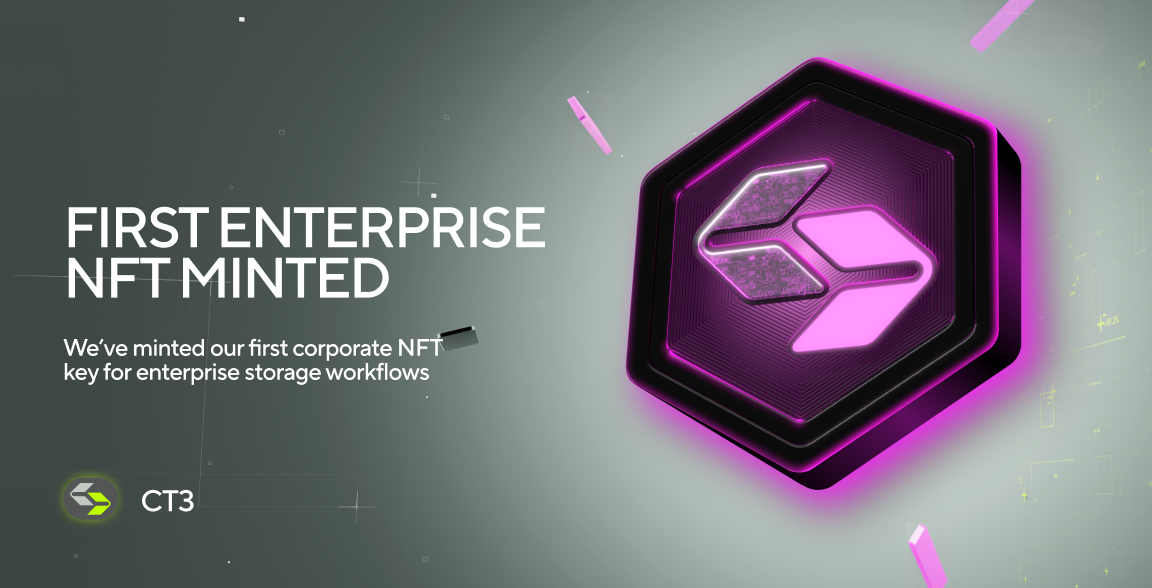
In the Web3 industry, there are many projects that claim to have technology, but very few that can prove real product demand at the business level. That is why the event that has taken place at CT3 is such an important milestone: as part of the contract with Smartsoft Engineering Ltd, the first corporate NFT access key (Enterprise NFT) has been issued.
At first glance, this may look like a standard NFT operation. However, in infrastructure projects, actions like this always mean more. The minting of a corporate NFT in CT3 is not a marketing gesture, but confirmation of a real signed B2B contract that defines the obligations of the parties, timelines, volumes, SLA parameters, and legal responsibility. Agreements of this kind are not made “on trust” — they go through standard approval procedures and are validated with official signatures, just as in any major traditional company.
That is why the issuance of the Enterprise NFT can be seen as the point at which CT3 enters the corporate sector.
Enterprise NFT Is Not a Token, but a Contract-Based Digital Access Identifier
The Enterprise NFT in CT3 has a specialized metadata structure adapted to corporate standards:
- File Name — the company name (client identification)
- Period — the term of the contract (in days)
- Size — 999 GB as the base parameter
It is important to understand that 999 GB is neither a limit nor a fixed tariff. It is a starting configuration, because CT3’s corporate model is built on the principle of on-demand provisioning, meaning resources are allocated as the client’s needs grow.
Companies cannot accurately predict their data growth in advance: archives, backups, AI datasets, documentation, media, and internal databases grow constantly. That is why the corporate market requires flexible infrastructure where storage volume can scale without the need to renegotiate the entire architecture.
CT3 implements exactly this approach: the client receives access to a corporate storage bucket, while the infrastructure expands according to the terms of the agreement.
Pink NFTs: A Corporate Access Key to the Entire Archive, Not Just One File
In the CT3 ecosystem, corporate keys are marked as Pink NFTs. Their fundamental difference is that they are not tied to a single specific storage object.
A Pink NFT functions as an enterprise-level access token — a system identifier that gives a company access to a dedicated corporate segment (dedicated storage space / bucket isolation).
Put simply:
a regular NFT is a key to one file,
while a corporate Pink NFT is a key to an entire corporate storage environment, including the company’s full archive stored under the contract.
This model reflects real business processes, where centralized access management to corporate data is required — but without the vulnerabilities of centralized clouds.
Why Companies Choose a Decentralized Storage Model Instead of Traditional Clouds
Centralized solutions such as Google Drive, Dropbox, iCloud, Microsoft Cloud, and others always carry a fundamental risk: a single control layer. Even if the infrastructure is distributed across data centers, access is still managed by one provider. This means:
- a single point of administration
- a single point of legal pressure
- the possibility of blocking or restricting access
- the risk of internal data leaks
- the risk of sanctions-related restrictions
- dependency on an infrastructure intermediary
In the corporate environment, this becomes a critical factor. Today, data is a strategic asset, and companies are increasingly looking for solutions that provide maximum autonomy, resilience, and control over access.
CT3 Architecture as an Infrastructure Layer: Resilience and Protection Against Compromise
CT3 is building its storage model as a censorship-resistant infrastructure layer, where information is distributed across many network nodes. Data does not exist in one place and does not belong to a single server.
From a security perspective, this means:
- no single point of failure
- high resilience to DDoS attacks and node outages
- no possibility of full compromise through a single server
- stronger protection against internal leaks
- the ability to scale without dependence on one provider
In addition, CT3 uses the principle of fragmentation: a file is split into multiple elements and distributed across the network. An individual fragment has no value on its own and cannot be reconstructed without access to the full structure and the key. This sharply reduces the risk of leaks, because even if part of the network is attacked, the attacker gains access only to meaningless data fragments.
Why This Is Strategically Important for CT3 as a Business
B2B contracts are not one-time payments. They are long-term agreements that create:
- constant demand for storage infrastructure
- predictable financial flow
- the ability to plan node scaling
- growth in the value and resilience of the entire ecosystem
- stronger market trust in the product
The corporate segment creates fundamental demand because companies work with data every day and cannot simply “stop storing” their archives. This means CT3 gains not a temporary wave of users, but a stable market with a constant need for storage.
Conclusion: The Enterprise NFT Is a Signal That CT3 Has Entered a Mature Phase of Development
The issuance of the first corporate NFT access key under the contract with Smartsoft Engineering Ltd is not just cooperation news. It is confirmation that CT3 is already capable of delivering an infrastructure solution for corporate clients that meets B2B market standards: with a contract, defined terms, access parameters, and scalable architecture.
In effect, CT3 is doing what any world-class technology company does: turning a Web3 idea into a real corporate product.
And that is exactly how the infrastructure of the future is built.