CT3 and Sabric Logistics Sign Storage Agreement

Rodrigo Pereira
Chief Marketing Officer
CT3 and Sabric Logistics Sign Storage Agreement
We at CT3 are pleased to announce a partnership agreement with the UK company Sabric Logistics Ltd. The cooperation covers long-term storage of documentation from transactions involving industrial equipment, vessels and aircraft, together with materials from the company's IT consulting projects.
This segment differs from typical corporate archives on two counts. Documentation here outlives the transaction itself and often outlives the relationship between its participants: a technical package for a vessel or an aircraft follows the asset for decades and is requested by new owners years after the deal closes. At the same time, that same documentation belongs to the most sensitive part of the brokerage business. A leak of the terms, or of the fact that negotiations are taking place at all, moves the price of an asset faster than any market factor.
Partnership details
The agreement covers storage of structured and unstructured materials that accompany the company's agency work: technical documentation on assets, inspection and valuation reports, contractual documentation and project materials from the IT division.
Integration proceeds in stages. In the first stage, the accumulated archive of closed transactions and historical technical documentation is migrated to CT3 Secure Storage. Work with active mandates follows, where materials are accessed regularly, along with controlled transfer of individual document packages to verified counterparties in accordance with the internal rules of Sabric Logistics.
About Sabric Logistics
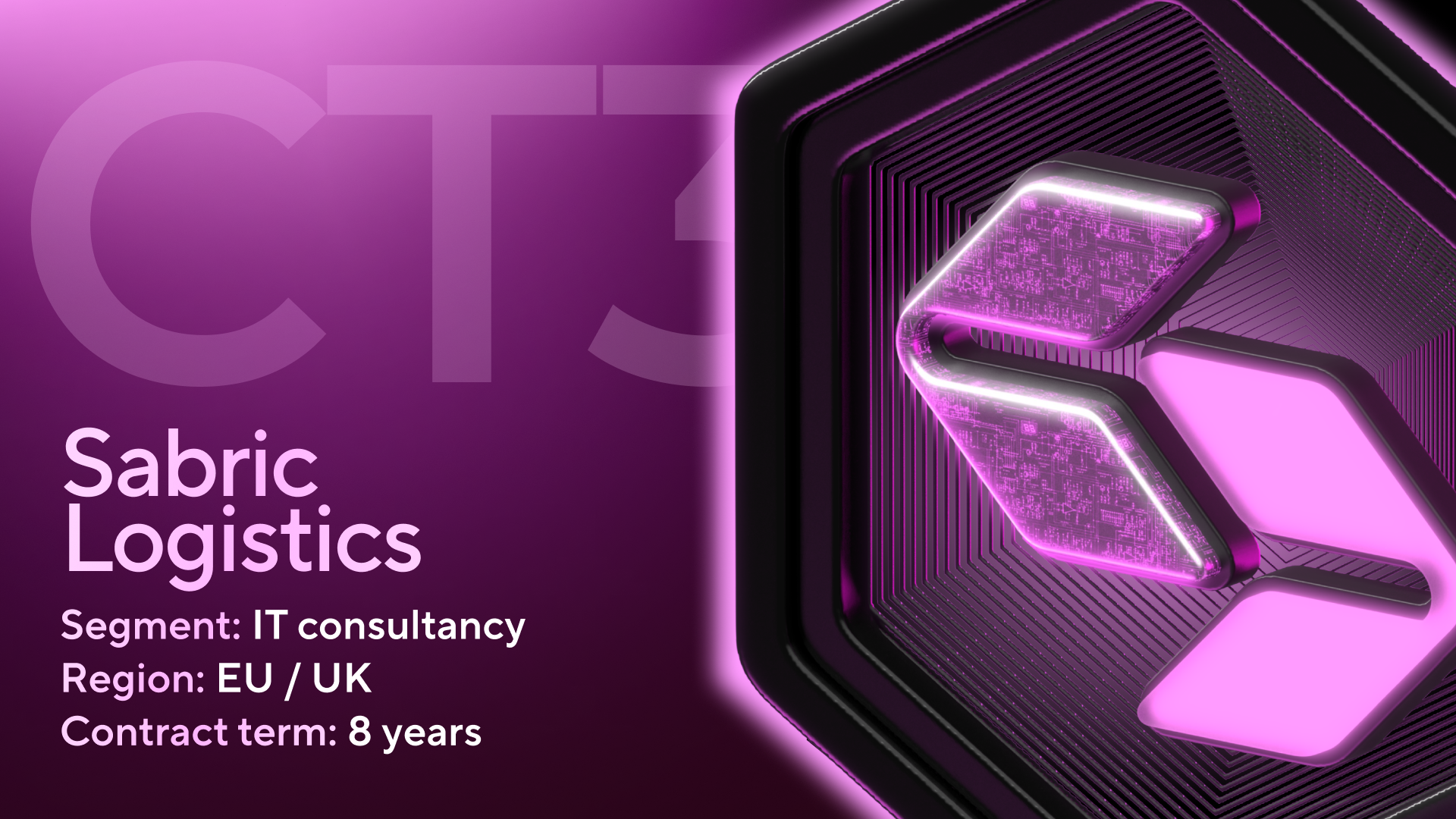
Sabric Logistics Ltd operates as an agent in transactions for the sale of machinery, industrial equipment, vessels and aircraft, and also provides IT consulting services.
The company works with sellers, buyers, surveyors, technical specialists and legal advisors at the same time, while remaining the only party that sees the full picture of a transaction. That position is what defined its requirements for storage infrastructure.
What data goes into storage
Capital asset transactions generate a large and heterogeneous body of documents. Under the agreement, the following is placed in CT3 Secure Storage:
- Technical packages on assets: manufacturer specifications, service history, running hours of units and components, certificates of conformity, registration and classification documents.
- Inspection and valuation materials: surveyor reports, pre-purchase inspection records, condition reports, valuation opinions.
- Visual records of asset condition: high-resolution photography and inspection video, including footage of hard-to-reach components. This is the heaviest part of the archive by volume and at the same time the part most often needed when disputes are examined years later.
- Contractual documentation: letters of intent, NDAs, agency and commission agreements, sale and purchase agreements, handover protocols, escrow instructions.
- Compliance documentation: counterparty due diligence results, export control and dual-use materials, supporting documents on the provenance of assets.
- IT division materials: project documentation, architecture descriptions, configuration databases, implementation reports and handover packages, a significant share of which is covered by confidentiality agreements with clients.
A separate difficulty with this body of data is that it is assembled from external sources. Documents arrive from manufacturers, registries, surveyors and counterparties, accumulate in email, messengers and file-sharing services, and by the time a package is actually needed it turns out to be scattered across several unconnected systems. Consolidating these materials into a single archive with verifiable integrity was one of the first tasks of the project.
Storage model and data architecture
The bulk of the data is placed in cold storage. These are archives of closed transactions, historical technical documentation and inspection materials that do not require regular access but must be preserved unchanged throughout the service life of the asset. This model provides long-term and economically predictable storage without loss of availability at the moment of request.
Part of the data is placed in hot storage. This covers materials on active mandates: document packages circulating between the parties to a transaction, recent inspection reports, documents under negotiation. These files must be available immediately and are requested by several participants in parallel.
The agreement also defines requirements for the geographic placement of nodes. Data and metadata remain within the agreed jurisdiction, the United Kingdom and the EU, with replicas distributed across verified nodes in the region.
Beyond the Contract
The agreement with Sabric Logistics opens a new segment for CT3: support for capital asset transactions where documentation outlives both the deal and its participants.
Beyond this specific contract, the case points to a shift in why companies choose decentralized storage. The first generation of such solutions answered the threat of data being deleted or blocked by a provider. The requirement that brokerage and consulting companies arrive with is formulated differently: what matters is not only that the data survives, but that the provider is not the party deciding who gets access to it and when.
In the CT3 architecture, that question is settled before a file is uploaded. Encryption is performed on the client device, integrity is confirmed by a hash written to the blockchain, and access rights exist as a transferable asset verified on-chain. Trust is replaced by verification, because the architecture enforces it.